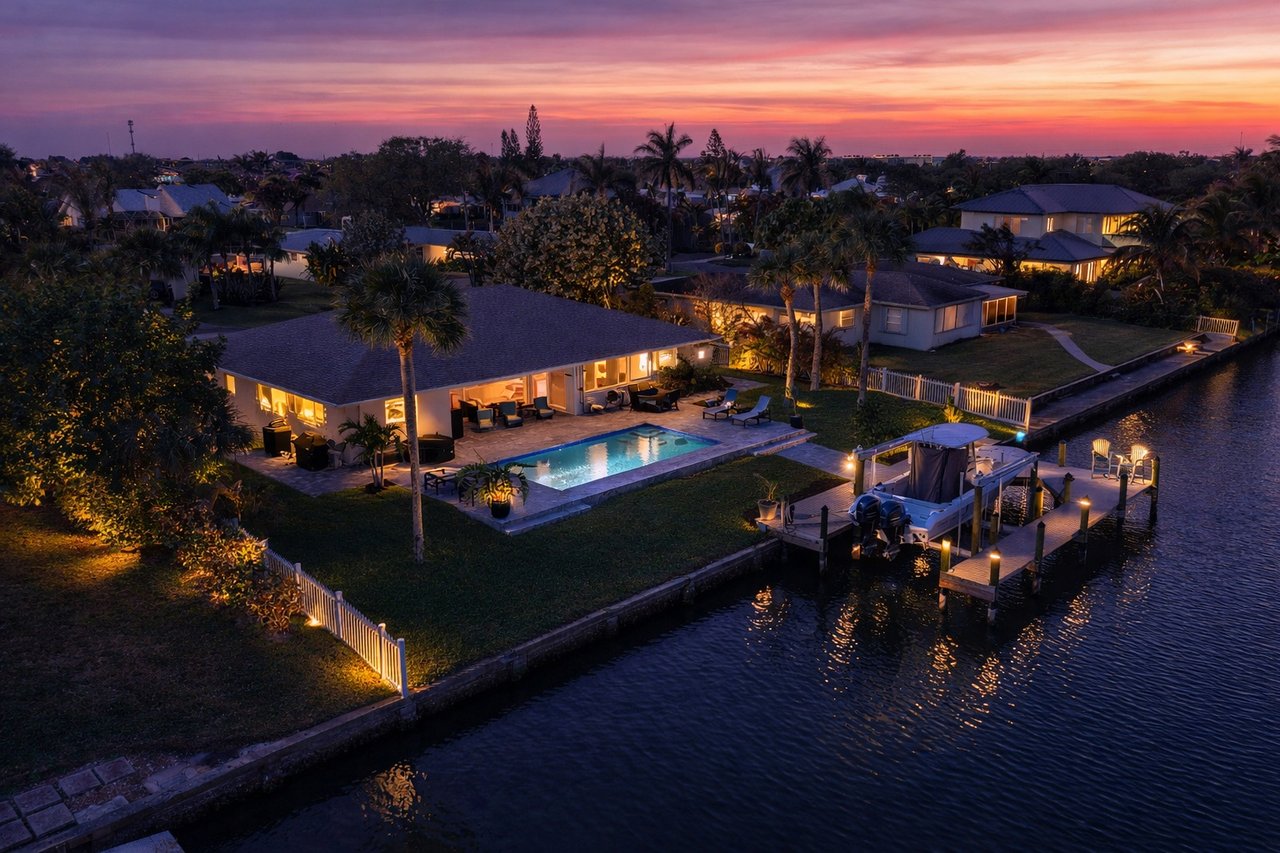
A dock in the backyard reads the same on every listing sheet. It should not. On the Vero Beach mainland, the words "direct waterfront" cover two very different assets, and the thing separating them is not price per square foot or lot width. It is 65 feet of air above the Indian River.
Every boat that leaves a mainland canal has to pass under two fixed spans on the way to the Atlantic. The Merrill P. Barber Bridge at SR 60 and the Alma Lee Loy Bridge at 17th Street were built as fixed concrete structures with vertical clearance of 65 feet. That number is the quiet arbiter of what your money is actually buying west of A1A this summer.
The rule the median hides
The Zillow Home Value Index for Indian River County sits at $372,662 as of May 2026, up 0.7% year over year, with typical listings going pending in about 27 days. That composite is a countywide blend of inland ranchettes, 55+ villas, and mainland canal homes. It tells you almost nothing about the mainland waterfront tier, and it tells you nothing at all about the mechanic that actually reprices these homes at the dock.
Here is the mechanic. Two homes can share the same canal, the same seawall condition, and the same interior finishes. If one sits east of both bridges and the other sits west, they are not the same product. The eastern home clears any recreational vessel out to the ocean. The western home clears anything under 65 feet of air draft and turns anything taller into a permanent liveaboard on the lagoon.
That is the piece portals cannot show you.
What "waterfront" means on the mainland, community by community
Vero Isles ("The Fingers"). A canal-finger neighborhood in the heart of the mainland with deep-water riverfront point lots, some offering more than 200 degrees of open water views. These lots sit inside the Barber Bridge's cone. A center-console, a small trawler, or a sportfish under the clearance line moves freely. A tall-mast sailboat does not.
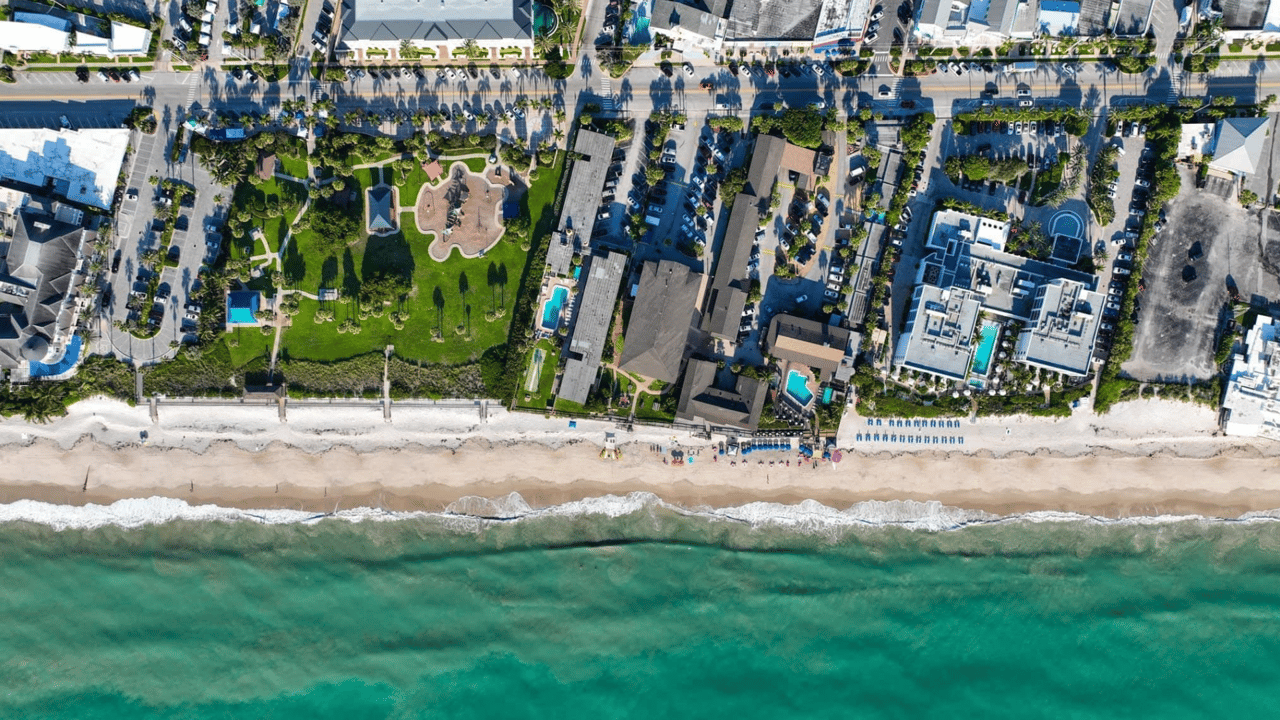
Grand Harbor. A guard-gated community on the Indian River with two championship golf courses, ten Har-Tru tennis courts, and one of the deepest marinas in Indian River County. Homes near the marina come with private docks and Intracoastal access. Grand Harbor's own beach club sits on the barrier island, which is the polite way of admitting that ocean sand still requires a bridge, by car or by boat.
Vero Shores and the non-HOA pockets. East of US 1 along the mainland's canal grid, buyers find waterfront enclaves where the covenants are thin or nonexistent. In several of these pockets it is entirely acceptable to keep a boat, an RV, or a work truck on your own lot. That flexibility does not exist on most of the island and does not exist inside Grand Harbor's gates. For a working boater it is worth real money.
Grove Isle, Millstone Landing, Isles of Waterway. Lake and canal communities where "waterfront" often means a protected view rather than direct navigable access to the lagoon. Read the listing carefully. A lake view is not a boat slip.
The 65-foot line, translated into buying decisions
The clearance question sorts mainland waterfront into four practical buckets.
- Runabout and center-console buyers. Every mainland dock works. Focus on canal depth at low tide, seawall age, and lift capacity. The lagoon's tidal range is modest, often around a foot, so wind-driven water matters more than the tide chart.
- Cruising powerboat under 65 feet of air draft. Every mainland dock still works, but distance to an inlet starts to matter. Sebastian Inlet sits to the north, Fort Pierce Inlet to the south, and both are the only ways out to open ocean from the lagoon.
- Tall-mast sailboat or sportfish with a tuna tower over 65 feet. The bridges rule out most of the mainland canals. Buyers in this bracket usually end up on the island side of the lagoon or accept that the boat lives at a coastal marina outside the county.
- Buyers who plan to keep a trailer boat on the lot. Community rules are the constraint, not the bridges. Non-HOA mainland pockets are the play.
If a buyer skips this exercise, they can pay a waterfront premium for a home whose water access does not match the vessel they intend to bring.
The stack of rules a mainland waterfront owner inherits
The bridge is only the first layer. A few other constraints move quietly into the closing file:
- The Indian River Lagoon segment between Vero Beach and Fort Pierce is a federally designated No-Discharge Zone, which means sewage stays on board and gets removed at a shoreside pump-out.
- Anyone born on or after January 1, 1988 who operates a vessel of 10 horsepower or greater in Florida must carry a Boating Safety Education ID Card issued by the FWC.
- Manatee protection speed zones cover portions of the county's waters, with idle-speed and slow-speed corridors that shape how quickly a boater can actually get from a private dock to the inlet.
None of this shows up on a listing. All of it shows up the first weekend you take the boat out.
Why mid-2026 is the negotiation window
Indian River County led the United States in cash home sales in 2025 at 62.7%, more than double the roughly 28% national share. That is the top-line number that gets repeated at cocktail parties. The more useful number is what the market has done since.
Countywide inventory has moved from a seller's posture into a buyer's posture. Rocket Homes tracked the average listing age at 91 days in the most recent reporting window, up roughly 19.6% year over year, and reclassified Indian River County as a buyer's market after the prior year's seller's market. Independent list-price data from broker aggregators shows resale inventory more than doubling from 2024 into 2025. Luxury forecasts for the coast in 2026 land at a modest 1–3% appreciation, with condo inventory in some segments rising 5–22%.
Put those three things together. A cash-dominated buyer pool, more inventory, and softening urgency. That combination changes how offers get written on mainland waterfront listings that have sat for 90 days or more, especially the ones priced against 2022 comps. Cash still closes fastest, but the seller no longer sets the tempo.
The window matters most on properties where the bridge math cuts against the seller. A seawall-fronting home marketed to sailboat buyers, sitting inside the Barber cone, is looking at a smaller pool of qualified purchasers than the listing implies. That is a price conversation, not a price take-it-or-leave-it.
How to read a mainland waterfront listing again
Three questions restructure the whole search.
Where does this dock sit relative to the bridges? Pull up a chart. The Alma Lee Loy Bridge crosses the ICW near Statute Mile 953. Anything south of that span, plus everything between the two bridges, is inside the 65-foot cone for outbound trips to Fort Pierce Inlet.
How far is the ride to an inlet in real time, not miles? Manatee zones and no-wake stretches turn eight statute miles into 45 minutes on some days. A dock that looks equivalent on a map is not equivalent on a Saturday morning.
What can I keep on the lot? Some mainland enclaves prohibit visible boat storage. Others treat it as a birthright. That single covenant decides whether a trailer, a jet ski, or a second vessel is part of the ownership picture at all.
Those questions do more work than the median.
Frequently asked questions
Are the Barber and Alma Lee Loy bridges ever opened for tall vessels? No. Both are fixed concrete spans. The old bascule Barber Bridge that used to open was removed after the 1995 replacement went in and was sunk offshore as an artificial reef. Clearance is 65 feet, period.
Which inlet do most mainland boaters use for ocean days? Sebastian Inlet sits to the north and Fort Pierce Inlet to the south. Choice depends on where you dock and, more honestly, on the day's conditions at each inlet mouth. Both are known for productive fishing water on the ocean side.
Does the mainland's cash-heavy market help or hurt a financed buyer right now? Both. It hurts because cash offers still win ties on the best listings. It helps because in a buyer's market, the seller of a long-sitting mainland waterfront home has fewer competing bids to compare against, which creates room for a financed buyer to negotiate concessions, credits, or a longer inspection period without losing the deal.
Is a mainland dock worth less than an island dock? Not automatically. For a runabout owner planning morning fishing runs and sunset cruises on the lagoon, a mainland dock at a lower total price often delivers the same daily experience for less money. The gap only opens for buyers whose boat cannot clear 65 feet of air.
Choosing a mainland waterfront home in this market is a two-part decision. The house is the easy part. The dock, the bridges, and the covenants around what you can keep in your own yard decide whether the home you buy matches the life you plan to live in it. That is the kind of read the composite median will never give you.
The Sutcliffe Group advises buyers and sellers across Vero Beach's mainland and barrier island communities with a concierge, negotiation-led approach. If you are weighing a canal home this summer, schedule a consultation and we will walk the bridge math, the community rules, and the current inventory with you before you write an offer.