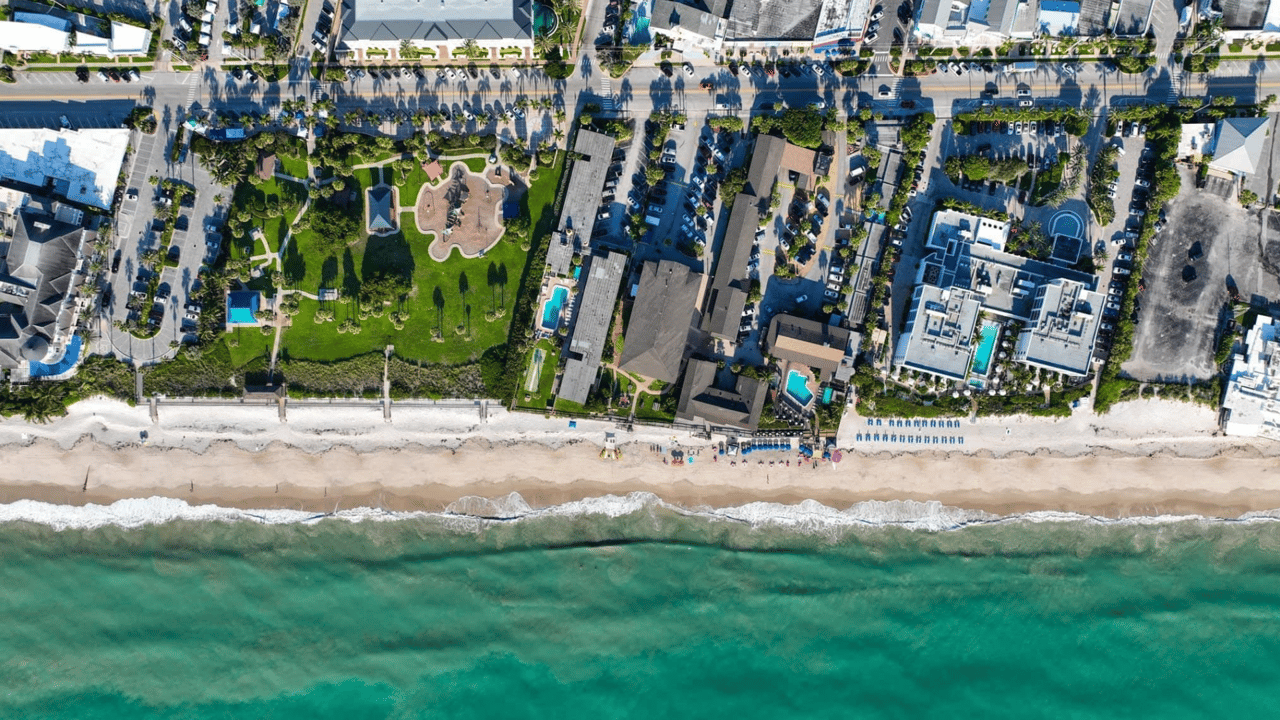
A buyer in Greenwich pulls up the barrier island on a portal, sees a median sale price hovering under a million, and books a flight expecting to tour homes at that number. Three days of showings later, nothing they liked was priced anywhere near it. The median was not wrong. It was simply describing a different market than the one they came to buy in.
The anchor number, and what it is mixing together
The barrier island sits inside a single ZIP code, 32963, and portals report one composite median across it. As of March 2026, Redfin's calculation put the 32963 median sale price at $950,000, down 17.4% year over year, with median price per square foot at $500 and 169 homes sold in the month. Zillow's home value index for the same ZIP sat at roughly $1.03 million with a typical time to pending of about 158 days.
Two numbers, one ZIP: a $950,000 sale-price median and a ~$1.03M value index, on an island where established Riomar homes routinely trade in the mid seven figures.
That gap is the whole point of this post. The composite is doing work the reader assumes it isn't doing.
How the composite gets pulled around
The March 2026 median dropped 17.4% year over year in a submarket where prime single-family inventory has not lost anything close to that. The reason is mix. Condo activity on the island surged into 2026 while condo pricing softened, and that combination bends the composite median downward even when the single-family segment holds firm. Local market reporting through 2025 and into early 2026 shows condo pending sales running dramatically higher year over year while condo median prices slid roughly 9%. Meanwhile single-family inventory tightened and closings on the island rose sharply against the prior year.
Put simply, the headline median is now weighted more heavily by a segment that is discounting, so it drifts down. A buyer who reads that drift as "island prices are falling" and expects to negotiate accordingly at the $2 million level is reading the wrong signal.
What each budget actually buys on the island in 2026
The table below is directional, drawn from island transaction patterns reported through spring 2026. Treat each band as a competition set, not a price tag.
Budget band | What is usually in it | What is usually not |
|---|---|---|
$700K to $1.2M | Older island condos, smaller interior lots away from the ocean, dated single-family homes needing work | Move-in single-family near Ocean Drive, direct water |
$1.3M to $2.4M | Renovated interior single-family in Central Beach and Riomar-adjacent streets, mid-tier condos with river or ocean orientation, some Sea Oaks product | New construction on premium lots, direct oceanfront |
$2.5M to $4M | New construction on scattered island lots, established Riomar homes on quieter streets, larger club-community single-family | Estate oceanfront, deep-water dockage without bridges |
$4M and up | Direct oceanfront, protected riverfront with deep-water dockage, larger Riomar and John's Island estates | Nothing categorical, but supply is thin and often off-market |
$700K to $1.2M: mostly a condo conversation
This is where the composite median sits, and it is the band where the softness is real. Condo inventory has widened, HOA scrutiny is more intense than it was two years ago, and buyers here are pricing in reserve studies, insurance renewals, and any special assessments the association is carrying. A financed buyer in this band actually has room to negotiate, particularly on units that have been sitting past the island's ~110-day average time on market.
$1.3M to $2.4M: the walkable-Central-Beach premium
This is the band that surprises out-of-state buyers most. The streets between Riomar and Bethel Creek have seen values climb dramatically over the last fifteen years, with the Vero Beach 32963 newspaper reporting that some homes in the corridor have appreciated as much as 1,000 percent over that period. What the money buys here is proximity, not size: a home you can walk from to Casey's or El Sid, to the beach, and to the Riverside Park cultural cluster in a single afternoon. Larger square footage exists at the same price further from the ocean, and buyers frequently trade one for the other without realizing the tradeoff until their third tour.
$2.5M to $4M: where new construction re-enters the conversation
GHO Homes announced in March 2026 that it is bringing six new 3,500-square-foot single-family homes to Central Beach on scattered lots between Camelia and Fiddlewood on both sides of Jimmy Buffett Memorial Highway, with pre-construction pricing from $2,975,000 to $3,225,000 plus lot premiums, per the Vero Beach 32963 newspaper. That establishes a floor for new-construction-on-a-good-street in the island's most walkable pocket. Established Riomar homes on quieter interior streets can trade in this same band, though inventory is limited and turnover is slow.
$4M and up: micro-market takes over
At this level the composite median is not useful at all. Riomar's average sale price sits in the mid seven figures, and direct oceanfront on Ocean Drive or protected riverfront with deep-water dockage can double the price of a nominally similar home a few blocks inland. Views, lot orientation, dock depth, and permanence of the outlook drive value more than square footage. This is the band where being off the wrong side of a bridge, or having a partially framed view rather than a direct one, is a six-figure decision.
The cash overlay changes the negotiation at every band
Indian River County has led the country in all-cash residential transactions, with recent reporting placing the share somewhere between roughly 63% and 81% depending on the window and the data provider. For a financed buyer, that share matters more than the median.
Three practical consequences to plan for:
- Contingency scrutiny is stricter across the board. When six or seven of every ten competing offers waive financing, sellers treat inspection and appraisal contingencies as real cost. A financed buyer keeps those contingencies but should tighten timelines and prepare to differentiate on certainty, not price alone.
- Days on market are a poor proxy for softness. Redfin's ~110-day average for the ZIP in March 2026 covers overpriced listings sitting alongside well-prepared homes that traded in weeks. The average is not the market you are buying.
- List-to-sale ratios are conservative but not generous. The barrier island's list-to-sale ratio has hovered near 85% in recent reporting, which means initial list prices are often set too high and then corrected. A 15% gap between list and sale is not a discount you should count on at your specific target property. It is a statement about the pricing discipline of the whole set.
How to read an island listing against this backdrop
Before the second showing, run the property through this short filter:
- Which segment is it in, single-family or condo, and how is the composite median pulling against it right now?
- What does the same money buy two streets in the other direction? If the answer is "materially more square footage but a longer walk to the ocean," the premium is location, not the home.
- If it is a condo, is the association's reserve position, insurance renewal, and assessment history documented?
- If it is direct water, is the view permanent (backing to a preserve, a park, or an ocean setback) or contingent on a neighbor's trees and a future teardown?
- What is the property's list history? A price cut from an unrealistic anchor is not the same as a discount from market.
The buyer who asks these five questions in order stops chasing a portal median and starts pricing the actual asset in front of them.
FAQ
Is the barrier island market softening in 2026? The composite median is down year over year, but the softness is concentrated in the condo segment and in overpriced single-family listings that have been sitting. Well-prepared single-family homes in walkable Central Beach and established Riomar streets continue to trade briskly.
Should I wait for prices to fall further before buying? That decision depends on the specific band. In the $700K to $1.2M condo band, patience has been rewarded through early 2026. In the $2.5M and up single-family band, inventory is thin and quality listings still see competing interest, often from cash buyers who are not rate-sensitive.
Does the 32963 median tell me anything useful? It tells you the shape of the whole ZIP. It does not tell you the shape of your budget's competition set. For that, the segment median, the specific street, and the property's list history matter more than the composite.
If you are underwriting a barrier island purchase from out of state and want the segment-level read rather than the composite, The Sutcliffe Group can walk you through the specific tier and street that fit your plan. Schedule a consultation.